Free 4-Voice MIDI Chord Progressions for Download!
| 4-Voices in Simple Rhythm & Common Time Signatures |
| If you like the demos, then why not get the whole library? That's over 314,000 patterns for one low price! |
 |
| 8,479 | Major Progressions | in | 2-4 | | 9,307 | Minor Progressions | in | 2-4 | | 28,366 | Major Progressions | in | 3-4 | | 33,187 | Minor Progressions | in | 3-4 | | 42,283 | Major Progressions | in | 4-4 | | 49,232 | Minor Progressions | in | 4-4 | | 15,241 | Major Progressions | in | 6-8 | | 18,015 | Minor Progressions | in | 6-8 | | 21,975 | Major Progressions | in | 9-8 | | 25,601 | Minor Progressions | in | 9-8 | | 29,307 | Major Progressions | in | 12-8 | | 33,274 | Minor Progressions | in | 12-8 |
|
(you can always remove it from your cart)
This is a VERY SPECIAL limited-time offer on downloads. 
You get over 314,000 MIDI CHORD PROGRESSIONS for only $59.98!
Sale ends at midnight 5/23/2013.
(Download contains exactly the same files as the CD except you can start using them immediately!)

If you aren't 100% satisfied with your order contact us within 30 days of your purchase for a full refund.
|
INTERNATIONAL ORDERS WELCOME!

INTERNATIONAL ORDERS WELCOME!
|
|
Once in a while a new compositional tool comes along and changes everything... MIDI Chord Progressions are a revolution in music creation and we’re very excited about what’s to come...
Here's a bunch of free MIDI Chord Progressions for you to download and experiment with. Each MIDI Chord Progression download has an mp3 demo next to it.
The mp3 demo is provided so that you can hear how the midi chord progression sounds with a good instrument. Each MIDI chord progression is four-bars long.
NOTE: To download the free midi chord progression click on the 'Free Midi Loop' links below. To hear how it sounds with a good instrument click on the Mp3 Demo next to it.
|

"I use these chord progressions every time I practice. I even used a few on my new album Intergalactic Highway."
|
More Information
Welcome to PROSONIC'S MIDI PROGRESSION SERIES! You've just found THE ULTIMATE CHORD PROGRESSION LIBRARY...
PROSONIC'S new 4-VOICE MIDI PROGRESSION SERIES went GOLD on June 17th 2009 and it's going to blow our creative possibilities wide OPEN!
This isn't like one of those old "chord dictionaries" in a paper book... It's a full-blown MIDI library that's over-flowing with thousands of professional, four-bar chord progressions in multiple time signatures!
You'd have to purchase hundreds of "chord dictionary" books to even come close to the content on this CD, and since they're all in MIDI, you can hear the progression instantly with any MIDI instrument you have. No paper book could ever do that!
This CD is like having a WHOLE LIBRARY of "chord dictionaries" and you can use the chord progressions in your own music royalty-free!
Each progression is carefully crafted to follow correct harmony & voice leading rules and the result is amazing! Each progression can have these chords: Major, Minor, Sus2, Sus4, MajorAdd9, MinorAdd9, Major6, Minor6, Dominant7, Dominant7Sus4, Major7, Major7-5, Minor7, and Minor7-5! All four inversions are included and each chord is notated with MIDI marker events so that you know exactly what harmony is voiced at each spot in the sequence! (see images below)
We've experienced instant inspiration and song writing has never been easier. Each MIDI progression is like a creative launch-pad for your melodic ideas and the 'next part' in the song just leaps out at you! Begging you to take it to the next section!
If you perform an instrument these progressions are an invaluable tool for perfecting your improvisation skills. I play guitar and these have instantly made me a better player.
Just randomly select a progression and loop it over one of the PROSONIC MIDI DRUM BEATS! If you get stuck on a chord and can't seem to find the right notes... just look at the MIDI marker and you'll know exactly what chord it is!
I've found the progressions incredibly useful for honing my bass and vocal phrasing too. I can put up a progression and score a bass line to it. It's really amazing what happens when you have a simple harmonic structure to work from. This is going to revolutionize our craft and I'm extremely pleased to share them with you.
"4-Voices in Simple Rhythm & Common Time Signatures" is a new library in the MIDI PROGRESSION SERIES. These progressions can be used in any style and are perfect for a base layer to build your song up from!
There are over 314,000 four-bar diatonic progressions in this library [and they all sound as good as (or better than) the demos] so be ready to stretch your sonic imagination beyond the limits!
Chord Progression Organization / Folder Structure
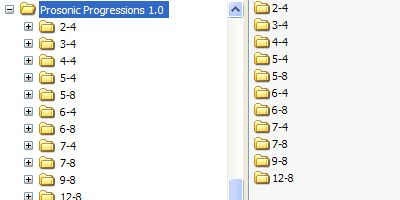
1. ROOT: The first folder is the ROOT folder. It contains all of the MIDI Chord Progressions. It is named Prosonic Progressions 1.0 and is selected (highlighted blue).
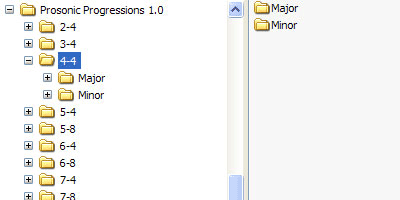
3. TONIC QUALITY: Each TIME SIGNATURE folder contains the TONIC QUALITY folders. In this case Major and Minor. Chord progressions in Major Key are found in the Major folder and progressions in Minor Key are found in the Minor folder. We currently have the Major folder selected.
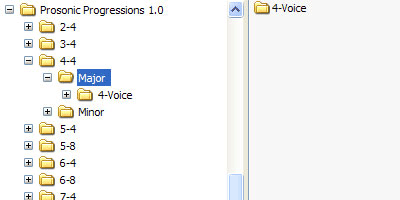
4. CHORD TYPE: Inside the TONIC QUALITY folders are the CHORD TYPE folders. We currently have the 4-Voice folder selected.
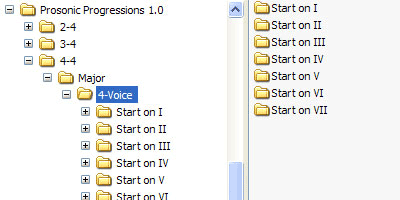
5. PROGRESSION START: Inside the CHORD TYPE folders are the PROGRESSION START folders. These folders contain chord progressions that start on each scale degree in the key. We currently have the "Start at I" (tonic in major) folder selected.
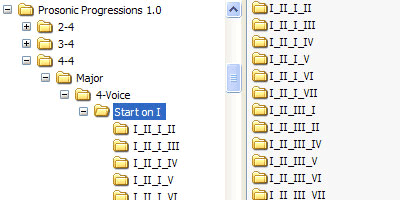
6. PROGRESSION: Inside the PROGRESSION START folders are the actual PROGRESSION folders. Each folder is named according to what progression it contains.
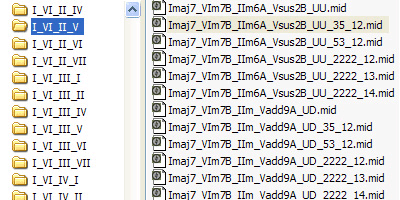
7. THE FILE: Finally we are at the actual MIDI files. (Examine the file name in the above image.) The file name contains a lot of information about the progression. Each part is seperated by an underscore character ('_').
The first four parts of the filename are the CHORD VOICINGS. If you look at the second file from the top (the one that is highlighted grey). You'll see that the chord progression starts with a Major7 chord with the Tonic as Root. (Imaj7)
The next chord in the progression is a Minor7 chord with the Submediant as Root. (VIm7) Notice that it has the capital letter 'B' after it. This means that the chord is in SECOND INVERSION.[The inversion key is: A = 1st inversion; B = 2nd inversion; C = 3rd inversion.]
The next two chords should be self explanitory now... [It then goes to a IIm6 chord in first inversion then a Vsus2 chord in second inversion.]
The next part of the file name is the MELODIC CONTOUR. This tells us the most prominent direction of the progression. The first letter (in this case 'U') shows the direction of the melody from chord-1 to chord-2 and the second letter (again the letter 'U') shows the melody from chord-3 to chord-4. The letter 'U' stands for Up, the letter 'D' stands for down, and the letter 'S' stands for Unchanged. So, in this instance we get a feeling of the progression going Up... and Up....
The next part of the file name is the BEAT GROUPING. Each digit represents the eighth note count in each beat. So, in the first file shown above, the Beat Grouping is 35. So there are 3 eighth notes in the first group, and 5 eighth notes in the second group.
The last part of the file name is the CHORD STOP INDICATOR. The CHORD STOP INDICATOR is comprised of two numbers. Each number shows what BEAT GROUPING the chords play on. So, if you look at the 5th file down, you'll see that the CHORD STOP INDICATOR is 13. This is not the number '13'! It is One - Three, and it means that the chords sound on the first BEAT GROUPING and the third BEAT GROUPING.
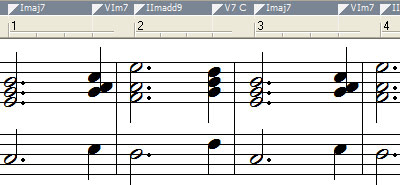
7. MIDI CHORD MARKERS: Inside each MIDI progression file are the MIDI CHORD MARKERS. Each chord stop and its chord symbol are provided. So, looking at the image below, each chord has its chord symbol (and its inversion) marked above it. So the first chord is the tonic major in second inversion, and the second chord is a minor second chord in first inversion, etc.
[This snap-shot was taken in Sonar by Twelve Tone Systems, Inc.]
MIDI Progressions Frequently Asked Questions
What is a MIDI File?
While the word "MIDI" is used to describe a few different things. A "MIDI file" can be thought of as "Sheet Music in Digital". (Sheet music that computers can read and play.)
Why use MIDI loops instead of audio loops?
MIDI is a superior method of music composition for a number of reasons.
If you've ever used audio loops to write music you know how frustrating it can be to get them to fit just right in your song. You might find a great drum loop but how can you develop it while keeping the same drum sounds? You can only make variations on the timbre of the sound itself and that's it.
With MIDI Phrases you have total control over every aspect of each note. Need to bring the hi-hats up in the mix? Easy! Need to change that note and make it sweeter? Just move it where you want it! Don't like a note... delete it!
You can also use a MIDI Phrase on any instrument. So you can use a drum Phrase on any instrument (flute or violin for example) and come up with very unique and creative musical ideas!
You can even change the tempo of a MIDI loop and the sound of the drums will be exactly as you sampled it.
What's a "4-VOICE MIDI CHORD PROGRESSION"?
We use the term "4-VOICE MIDI CHORD PROGRESSION" to mean: a 4-bar musical chord progression (in MIDI) where each chord has 4-Voices and is crafted to follow correct harmonic and voice leading rules. Each chord may contain these formulas: Major, Minor, Sus2, Sus4, MajorAdd9, MinorAdd9, Major6, Minor6, Dominant7, Dominant7Sus4, Major7, Major7-5, Minor7, and Minor7-5; in all 4 inversions!
What software can I use MIDI Chord Progressions in?
Every 4-VOICE MIDI CHORD PROGRESSION is compatible with, and can be loaded into, any MIDI compatible software or hardware device (ie: your favorite sequencer).
Loading them into Propellerhead's Reason™ and Twelve Tone's Sonar™ has been especially rewarding. They are perfect for Cakewalk Project5, Battery 3, Cubase, Garageband, Pro Tools, Motif ES, Fruity Loops, EZdrummer, DFH, Sony's ACID® Pro, Ableton Live, and many more!
|